2003: The Year of the Enthusiast
During the early 2000s, automotive options were scarce for consumers looking for enthusiast vehicles to chose from. The golden age of the JDM era had passed, and the American Muscle market was limited to that of Mustangs and Corvettes. Other notable deterrents were the high cost of ownership, practicality and efficiency had become the priority, and all-in-all enthusiasm for performance had dwindled. But then, something happened. A new movie franchise, “The Fast and the Furious,” sparked a cultural shift amongst young Gen X and Millennials who were inspired by the film, which renewed their passion for performance and thrills. In the following two years after the film’s release, new cars would emerge energized by the movie’s success. I will elaborate on specific vehicles introduced for the 2003 model year.
Nissan 350z
Fortunately, after a six year hiatus, Nissan revived the Z nameplate with the all new Nissan 350z (Z33). Boasting a naturally aspirated 3.5 liter DOHC V6 Engine (VQ35DE), mated to a close ratio 6-speed manual transmission, the 350z produced an impressive 287 horsepower and 274 lb-ft of torque to the rear-wheels, later increased to 306 horsepower. Its attractive styling, indestructible reliability, and affordable pricing gained significant interest among entry level buyers. During this time, the only other affordable rear-wheel drive sports car coming out of Japan was the Honda S2000. As a former 350z owner, I can attest to the fact that it really did preserve the tradition as an old-school, simplistic car capable of providing the driver with a euphoric experience.

2003 Nissan 350z Track Edition. Photo provided by Cars & Bids
Dodge Neon SRT-4
Dodge, in the new millennium, had little to offer in their performance lineup besides the ultra-expensive Dodge Viper. Dodge took note and sought to engineer a cheap, high-performance vehicle for young enthusiasts on a budget. The Dodge Neon SRT-4 was their answer. Equipped with a 2.4 liter DOHC turbocharged inline-4 engine (A853), mated to a 5-speed manual transmission, the SRT-4 churned out an impressive 215 horsepower and 245lb-ft of torque, later increased to 230 horsepower. That is a staggering powerband for a front-wheel drive car. Even though the SRT-4 gets a bum rap for ultimately being a Neon, I really admire the aggressive styling. It should be noted that the SRT-4 production run was prior to that of the sixth generation Dodge Charger (2006) and third generation Challenger (2008). The Dodge Neon SRT-4 couldn’t hold a candle to the Subaru Impreza WRX or the Mitsubishi Lancer Evolution, but it held its own.
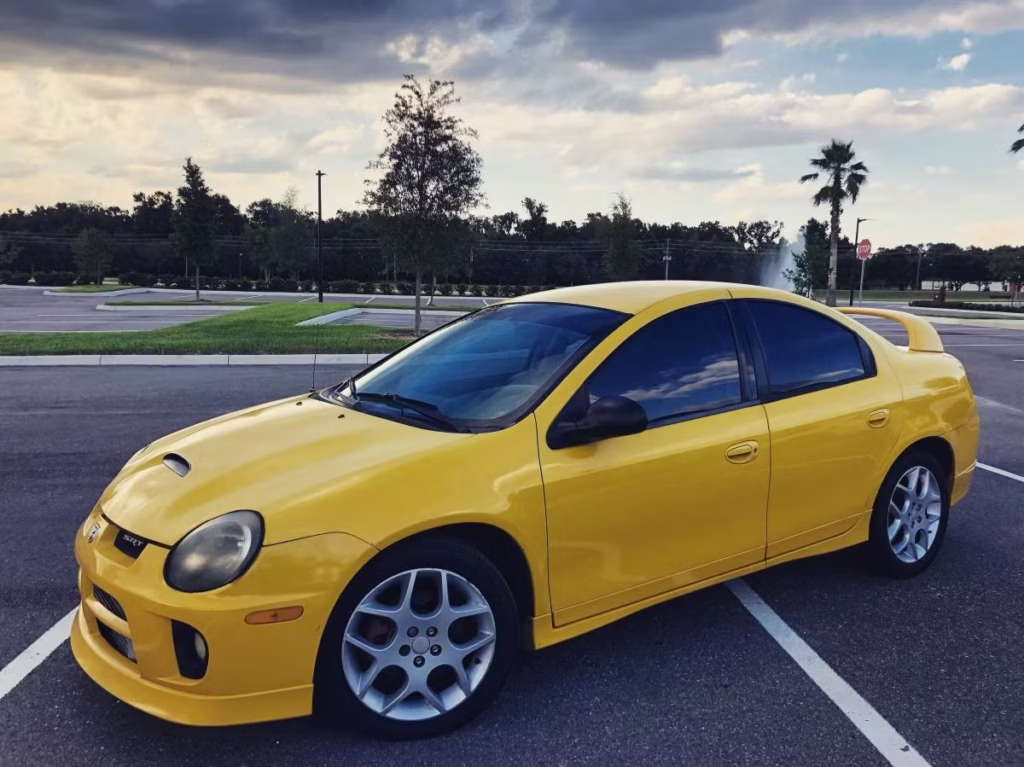
2003 Dodge Neon SRT-4. Photo provided by CarBuzz
Mitsubishi Lancer Evolution VIII
Finally, America got the long awaited Evo. After eleven years and eight generations, perseverance paid off when the highly anticipated Mitsubishi Lancer Evolution “Evo” arrived in the American market. With the success of its Subaru counterpart (Impreza WRX) in the U.S. in 2002, Mitsubishi decided it was time to give the people what they wanted. And what did we want? A raw, all-wheel-drive, rally inspired car capable of handling the abuse of high-revving output and superior handling in its natural habitat on twist-windy backroads. Its engine, the 4G63, is revered as one of the best four cylinder engines ever manufactured. The fortified iron block of the 4G63 enabled it to handle the forced induction from its twin-scroll turbocharger, all while the notchy 5-speed manual transmission assisted in matching precise shifts to stay within the boost threshold. As a proud owner of an Evo, thank you, Mitsubishi, for giving me the car of my dreams.

2003 Mitsubishi Lancer Evolution VIII. Photo provided by Mitsubishi
Ford Mustang SVT Cobra “Terminator”
The ’99 Ford Mustang SVT Cobra was underwhelming in terms of promised performance. Originally advertised by Ford with the capability to produce 320 horsepower from its naturally aspirated 4.6 liter V8, the 281 cubic inch engine, it was actually DYNO tested at a lesser figure between 280-290 horsepower. This was a disappointing to those who had paid a higher premium to upgrade from the GT trim. Keep in mind the earlier mentioned Nissan 350z has two less cylinders than the Cobra and it still produced 287 horsepower. Faced with class action lawsuits, Ford issued a stop-sale on further production of the Cobra, with the exceptions of the 2000 Cobra R as well as limited production numbers of the 01-02 Cobra. So, in 2003, Ford sought to redeem themselves from the lackluster reception of the SVT Cobra with an all new Cobra. The Ford Mustang SVT Cobra “Terminator” featured the 4.6 liter V8. This time, it was completely revised with an iron block, as well as forged Manley H-beam connecting rods fitted to the already produced forged crankshaft. All of this engine reinforcement is attributed to the Eaton supercharger that was retrofitted to the Terminator, providing it with instantaneous boost that rounded its power up to 390 horsepower. Ford was conservative with this estimate, however. DYNO testing revealed the Terminator to produce upwards of 430 horsepower and 425 lb-ft of torque. Also, the Terminator received a new 6-speed manual T-56 Tremec transmission and updated exterior styling. The Terminator’s performance, looks, and redemption by Ford earned its rightful place as an eventual collector car.

2004 Ford Mustang SVT Cobra “Terminator” Finished in Mystichrome. Photo Credit Unknown